
If you only have 60 seconds:
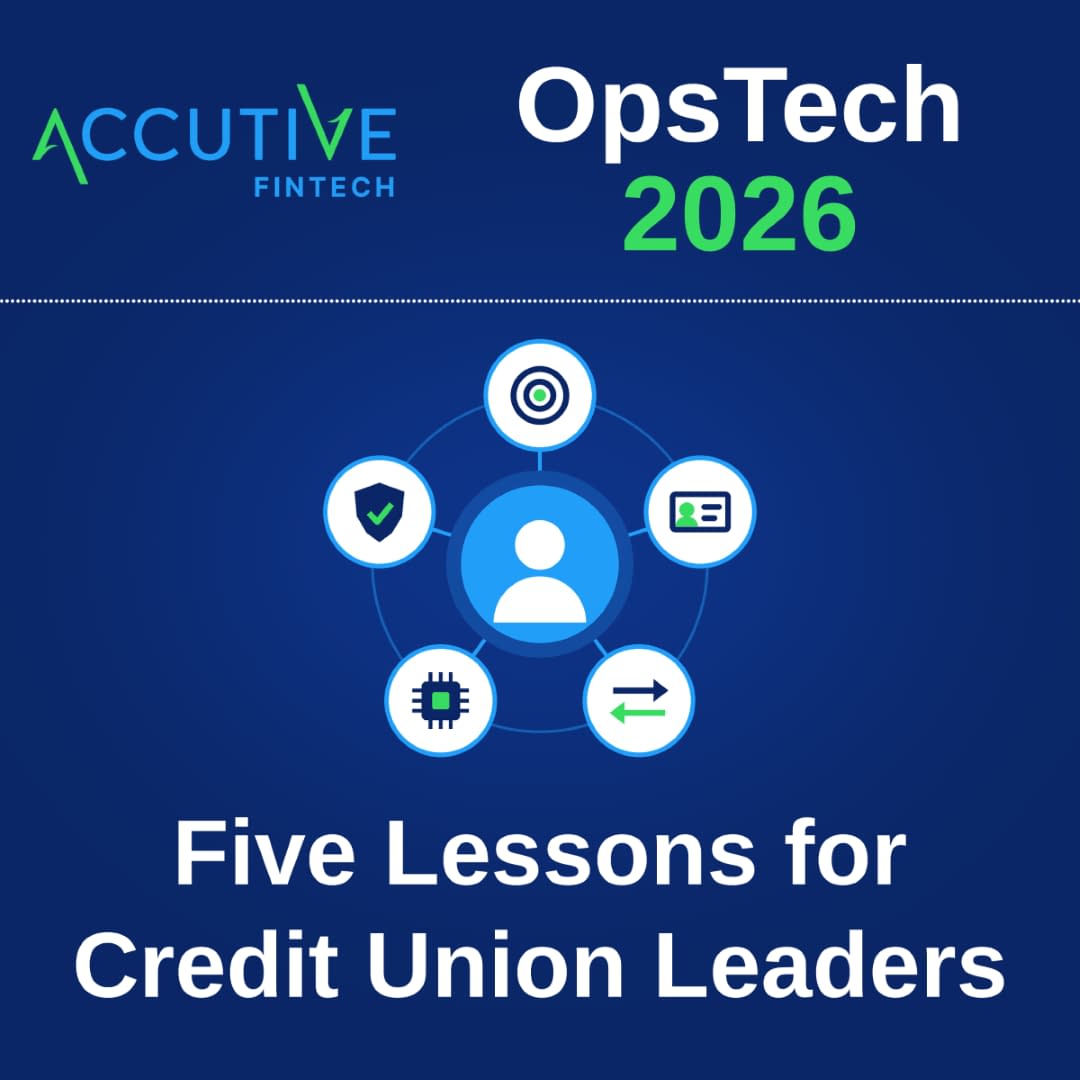
Here is what OpsTech 2026 means for your digital onboarding platform and beyond:
- Pick a member and a need. Chime is winning through focus, not features.
- Onboarding is the relationship. Your digital onboarding platform should deliver fewer fields, instant decisions, and instant funding.
- Payments are about certainty, not speed. Fund clarity and recourse, not just rails.
- AI fails on process, not technology. Redesign the work, then remove it from the queue.
- Fraud moved to the credential. Fight it earlier and measure it honestly.
- Build for reuse. Every integration should make the next one easier.
In late September, I spent four days in Las Vegas at the America’s Credit Unions Operations and Technology Councils’ Conference (September 21 to 24). One slide summed up the week. In his payments orchestration session, James White of EngageFI put it plainly:
“No member has ever asked you for FedNow.”
Members ask whether their money has arrived and whether a payment went through. Those are questions about certainty, not speed, and that gap between the product and the outcome ran through almost every session I attended. Here are the five themes that matter most for your credit union.
1. Focus beats features: no digital onboarding platform replaces a clear segment
Drew Hyatt of Veep Software gave the week’s most uncomfortable session: Why Chime is Winning. Credit Unions Need to Wake Up. Citing Chime’s Q2 2026 earnings, he reported 10.4 million active members (up 20% year over year) and $115 million in monthly revenue from MyPay, its earned wage access product.
Chime did not get there with a better app or with AI. Instead, it picked a segment (workers under 40, often living paycheck to paycheck and earning under $100,000) and solved their real problem, which is timing rather than budgeting: a $125 bill due tomorrow, $50 in the account, and a paycheck five days out.
However, the comparison has limits. Chime operated unprofitably for more than a decade, which the NCUA would not allow the average credit union to do. In other words, the lesson is Chime’s discipline, not its economics. Credit unions already hold the deposit relationship, the transaction history, and member trust; what is usually missing is a clear decision about who you are serving and what problem you are solving.
Harrison Hochman of Sparrow showed how timing, targeting, and personalization change the conversation. Instead of “I noticed you don’t have an auto loan” on day 30, the message becomes “You’re in month 31 of a 48-month auto loan. It’s common to think about a trade-in around now.” Done well, he reported a 60% lift in lending conversion and a 45% lift in core deposit conversion.
Takeaway: Stop optimizing across every segment. Pick the member, define the need, create the offering, and measure the result.
2. Your digital onboarding platform is where the relationship starts
Accutive sponsored this session, so I acknowledge my bias. Brian Day (Velera / Advisors Plus) and Jason Wolkove (CTO, Premier America Credit Union) described digital banking moving toward projected balances and proactive recommendations, then set out four critical capabilities for digital account opening:
- Efficient data entry. Completion rates rise as required fields fall. Delta Community Credit Union prefills the application after the applicant enters a mobile number, date of birth, and a one-time passcode.
- Immediate decisioning. If an application drops into a manual review queue, everything downstream, including instant digital card delivery, loses its value.
- Account funding. Digital wallet and P2P funding options are still uncommon, but they are a real opportunity with younger members.
- Digital card delivery. Members can start transacting on day one.
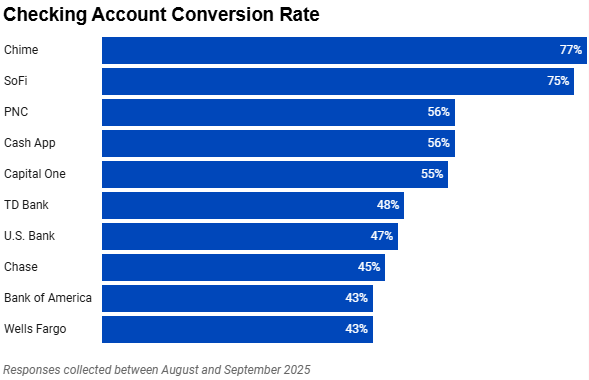
I have spent 25 years in account opening, and too many institutions still treat it as a form rather than the first chapter of the relationship. Whatever digital onboarding platform you run, every click, keystroke, and minute contributes to abandonment. For example, J.D. Power research on how customers open new accounts reports a 77% checking account conversion rate for Chime.
Takeaway: Fewer fields, instant decisions, instant funding, and an instant card. Then keep showing up.
3. Payments: speed is the headline, confidence is the product
White argued that members want three instants, and most institutions fund only one:
- Instant movement. The money arrives when expected. This is what most modernization budgets pay for.
- Instant clarity. A status the member can read without calling.
- Instant recourse. A path to resolution that works on a Saturday night, not just Tuesday at 10 a.m.
His Saturday night scenario made it concrete: rent sent at 8:40 p.m. holds for review, the app says “processing,” nobody can be reached, and by Monday morning the landlord has charged a late fee. In short, every failure in that scene is an orchestration decision, not a rail decision.
Two further points deserve attention. Members do not complain; they reroute, so deposit displacement shows up as an account that still exists but no longer does anything. And hubs connect rails, while orchestration chooses between them. White’s test for any vendor: can your team change a routing rule itself, this week, without opening a ticket?
If your institution is planning for real-time payments, review Australia’s experience before you finalize your roadmap. Its New Payments Platform went live in 2018, giving it eight years of lessons, including the fraud burden that shifted to institutions. Early adopters benefited, so the lesson is not to wait: it is to go in with your fraud exposure fully understood.
Takeaway: Focus on use cases. Ship consistency first (one set of status messages, alerts, limits, and dispute intake across every rail), then expand use cases, not rails.
4. AI fails on process, not technology
The most useful AI sessions explained why AI usually does not deliver. Andres Klaric of Fuse cited the MIT finding that 95% of AI pilots never reach production, largely because teams keep doing the same work: staff do not trust the AI, still own the outcome, and were never retrained.
His method: give the AI your team’s existing instructions, train it past human accuracy, remove the work from the queue once it passes a 99% accuracy threshold, and QA it outside the live process. As he put it, “If your team can still touch every loan, they will.” One midsized credit union client moved from 60% to 82% automated document processing.
Marty Mitchell of Managed Financial Networks offered my favorite line of the week:
“We didn’t remove the risk work. We removed the administrative work around the risk work.”
Governance does not have to wait for scale. For instance, Foothill CU, a sub-$1 billion team, uses a Govern, Protect, Enable, Prove model with a central AI inventory and a hard rule of zero unapproved PII in AI systems. Its guardrails: start with low-risk internal tasks, always keep a human reviewer, and prove one use case before expanding.
Charlie Peterson of Allied Solutions showed the industry shrinking from 22,500 credit unions in 1985 to 4,300 in 2026. His advice: stop adding point-to-point integrations and build a reusable data and API layer, so the next initiative, whether a new digital onboarding platform or an AI use case, is easier than the last.
Takeaway: Don’t bolt AI onto a broken process. Redesign the work, govern the data, then take it off the team’s plate.
5. Fraud didn’t disappear, it moved
Lon Varns of Aries Fraud Solutions argued that the problem is not the tools but where institutions fight the battle. Card-not-present fraud accounts for 82% of card fraud losses (Nilson Report), and every $1 of fraud costs about $5.75 once operations, reissue, staff time, and member impact are counted (LexisNexis True Cost of Fraud, 2025).
Yet most defenses engage only after a credential is already in the wrong hands. Varns left the audience with three questions:
- Where does a stolen credential still have value?
- How much of our fraud strategy engages before the transaction?
- Are we measuring the full impact, or just the fraud-loss GL?
Takeaway: Protect the credential, make stolen data less useful, and measure the real cost.
What this means for your institution, beyond the digital onboarding platform
Every session above pointed to the same outcomes: member growth, deposit growth, lending growth, and deeper engagement. Getting there takes a clear decision about which member need you are solving, the right partners, and the discipline to execute.
That is why Accutive sponsored this year. We work as a growth partner for credit unions, helping them select and implement the right fintech solutions, with partners including Temenos, Prove, Eko, and Naehas, and adopt AI in a controlled environment where governance and data protection come first. Our AI Lab supports co-creation work with credit union clients.
So the real question is not which rail, platform, or model to buy next. It is which member, and which need, your institution will solve for first. If any of these themes reflect challenges your team is working through, I would welcome the chance to compare notes. Email me directly to start the conversation.